













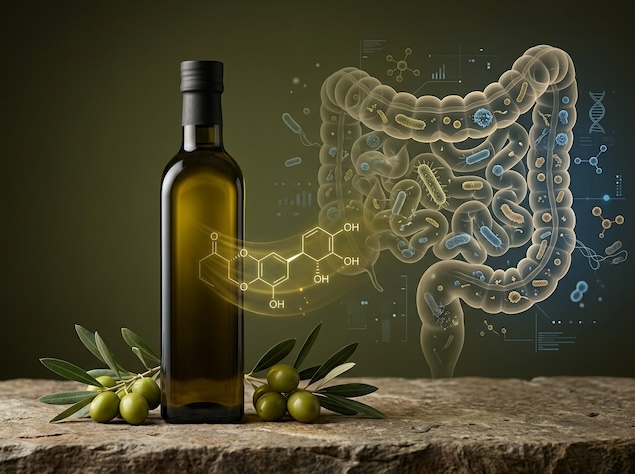
Oleocanthal from Corfu vs. Colorectal Cancer — A New Study and Dosage Calculations
The oleocanthal used in the study was isolated from Greek olive oil called “The Governor.” After 21 days, tumor mass in mice was reduced by 97.6–99.1%.
Scope of this article. We describe a preclinical study in an animal model, conducted using an isolated chemical compound with a purity of ≥99%, rather than olive oil as a food product. We report only the facts presented in the publication. This text does not constitute medical advice or a health claim regarding any product.
In August 2026, the journal Nutrients published a paper that sounds like a headline from a tabloid health magazine — yet it is a rigorous preclinical study from an American university. Mice with aggressive colorectal cancer were administered oleocanthal orally via a gastric tube. After 21 days, tumor mass was reduced by 97.6% in males and 99.1% in females.
But the most interesting result doesn’t concern the tumor. It concerns gut bacteria. And the most practical conclusion concerns how much oleocanthal is actually in a bottle of olive oil—because the variation on the market is a hundredfold.
Who Conducted the Study
| Center | College of Pharmacy, University of Louisiana at Monroe (USA) |
| Authors | Md Towhidul Islam Tarun, Hassan Y. Ebrahim, Khalid A. El Sayed |
| Publication | Nutrients 2026, 18(16), 2623 — open access |
| Date | August 11, 2026 |
| DOI | 10.3390/nu18162623 |
Where the raw material came from. Oleocanthal for the study was isolated from Greek olive oil The Governor from Corfu. The authors thanked the Dafnis family for providing the raw material. The substance had a purity of ≥99%, as confirmed by NMR spectroscopy.
What is oleocanthal
It is a dialdehyde secoiridoid found exclusively in extra virgin olive oil. Chemically: p-HPEA-EDA. It is formed during pressing when enzymes in the fruit break down ligstrozyde into its dialdehyde form. Oleacein is formed from oleuropein in the same way.
Sensory-wise, oleocanthal is the compound that causes a scratchy sensation at the back of the throat and can trigger a cough in someone trying young, early-harvest olive oil for the first time.
Oleocanthal is not a “polyphenol”—it is a separate compound identified in a separate study
It’s worth pausing here for a moment, because this is where most of the confusion arises.
The popular term “polyphenol content” refers to the sum of all phenolic compounds in olive oil, determined by chromatography according to the COI standard and expressed in mg/kg as tyrosol equivalent. This is a single aggregate value. It says nothing about exactly which compounds make it up—and it consists of hydroxytyrosol, tyrosol, aglycones, lignans, phenolic acids, flavonoids, and secoiridoid dialdehydes. Two olive oils with an identical total polyphenol content can have extremely different profiles.
The oleocanthal content itself, however, is determined by quantitative nuclear magnetic resonance spectroscopy—qNMR. This method measures the signals from the aldehyde protons of a specific molecule and reports its concentration separately. On the qNMR certificate, you will find three adjacent entries: Oleocanthal, Oleacein, and their sum described as Oleocanthal+Oleacein (index D1).
Beware of a common mistake. Index D1 is the sum of oleocanthal and oleacein, not oleocanthal alone. The study described here pertains exclusively to oleocanthal, which is why in the calculations below we use the separate oleocanthal value from the certificate, rather than the D1 index. We list both numbers side by side to avoid any confusion.
You can find the qNMR test results with the values for oleocanthal, oleacein, and the D1 index in our store, listed next to each product.
Athymic mice were implanted with human colorectal cancer cells directly into the wall of the cecum—not under the skin, as in more convenient models. This is important: the tumor grew in its natural environment, in close proximity to the microbiota.
The HCT-116 cell line with the KRASG13D mutation was used. KRAS mutations occur in 40–50% of colorectal cancer cases and cause the tumor to be resistant to anti- -EGFR therapies. No effective inhibitor has yet been discovered for the G13D variant.
Four groups of 6 males and 6 females each, 21 days:
- Placebo — extra virgin olive oil with chemically removed phenols (dpEVOO) plus antibiotics to sterilize the intestine
- Oleocanthal administered orally — 10 mg/kg daily, via a nasogastric tube
- Oleocanthal administered orally + antibiotics
- Intraperitoneal oleocanthal — 10 mg/kg, 3 times a week, bypassing the gastrointestinal tract
Note the control group: it consisted of phenol-free olive oil, i.e., the same fat without the active fraction. This comparison isolates the effect of oleocanthal alone.
First result: the route through the gut wins hands down
Pharmacologically, this is a surprise. Intraperitoneal injection bypasses the gut and liver, so it should result in higher systemic exposure—and a better effect, if oleocanthal acted directly on tumor cells.
| Group | Females | |
|---|---|---|
| Placebo | 7,404.5 mg | 6,540.1 mg |
| Oleocanthal via the gastrointestinal tract | 178.4 mg (−97.6%) | 62.6 mg (−99.1%) |
| Oleocanthal orally + antibiotics | 212.8 mg (−97.1%) | 262.6 mg (−96.0%) |
| Intrathecal oleocanthal | 2,617.7 mg (−64.5%) | 1,968.0 mg (−69.9%) |
Via the gastrointestinal tract: 97–99%. Intrathecally: 64–70%. Something is happening in the intestine.
Metastases confirm this picture. Bioluminescence was examined in eight organs. In the placebo group, involvement of the liver, intestines, spleen, and kidneys was 100%, with metastases to the bones, brain, and lungs in some animals. In females receiving oleocanthal orally, no metastases were found in any organ other than the intestines. In the intraperitoneal group, the spread remained extensive: liver 4–5 out of 6, intestines 6 out of 6, spleen and kidneys 5 out of 6.
Furthermore, animals receiving the compound orally maintained a stable body weight, while the placebo group progressively lost weight—a pattern consistent with cancer cachexia.
Second finding: the effect could be transferred via feces
Since the gut is key, the authors asked directly: is it the microbiota?
Healthy donor mice were given a high dose of oleocanthal (20 mg/kg) for a week. Their fresh feces—processed anaerobically within 30 minutes of collection, while maintaining donor-recipient sex matching—were administered to mice with tumors, whose guts had previously been sterilized with antibiotics. The recipients did not receive a single milligram of oleocanthal.
| Group | Males | Females |
|---|---|---|
| Transplant from placebo donors | 9,252.2 mg | 6,594.8 mg |
| Transplants from oleocanthal donors | 48.5 mg (−99.5%) | 38.4 mg (−99.4%) |
| 211.2 mg (−97.7%) | 186.8 mg (−97.2%) |
The transplanted microbiota alone resulted in lower tumor mass than direct administration of oleocanthal. In males, the only metastasis was a single case of kidney involvement. The rest of the organs remained free of metastasis.
Oleocanthal remodeled the gut bacterial ecosystem such that that when this ecosystem was transferred to another animal, it reproduced the effect on its own.
Mechanism: two epigenetic switches
A Western blot showed that oleocanthal reduces the expression of two lysine methyltransferases—SMYD2 and EZH2—which have been described as oncogenic drivers of colorectal cancer. SMYD2 methylates EZH2 and suppresses APC2, which inhibits the Wnt/β-catenin pathway.
Reduction in the group receiving the compound orally: SMYD2 by 65–71% , and EZH2 by 86–88%. The order of efficacy was always the same—oral administration, followed by oral administration with antibiotics, and finally intraperitoneal administration. Exactly as with tumor burden and metastases.
In the fecal transplant group, the suppression of SMYD2 and EZH2 was virtually identical to that observed with direct administration of oleocanthal, in both sexes.
How much oleocanthal do real olive oils contain—five examples from certificates
Before we get into the math, it’s worth seeing what the range looks like in practice. Below are five olive oils from the 2025/26 season with qNMR results from the World Olive Center for Health, signed by Prof. Prokopios Magiatis (University of Athens). Each entry represents a separate analysis of a specific batch.
| Olive Oil | Variety / Harvest | Oleocanthal | Oleacein | D1 Index | Total polyphenols |
|---|---|---|---|---|---|
| Sparta (Λ25) | Agrielia (wild) / IX 2025 | 2,040 | 901 | 2,941 | 3,443 |
| Pamako Organic Monovarietal | Tsounati (Organic) / Nov. 2025 | 1,318 | 264 | 1,582 | 2,081 |
| Olive Poem (season 25/26) | Koroneiki + Myrtoelia | 1,083 | 414 | 1,497 | 2,189 |
| The Governor Limited Edition | Corfu / X 2025 | 577 | 298 | 875 | 1,316 |
| NUMA* | Picual, Spain / October 2025 | 138 | 127 | 265 | 722 |
| Average supermarket olive oil | — | — | — | usually unlabeled | ~200 |
All values in mg/kg, qNMR method (World Olive Center for Health). Average store-bought olive oil falls within the range of 100–300 mg/kg of total polyphenols and usually has no measurable D1 index at all.
* Methodological note regarding the NUMA entry: this is a product from another supplier, not part of our product line, marketed as olive oil with a high polyphenol content. We include it solely as a reference point for the figures, since we receive numerous inquiries about it. We provide only the values from the qNMR certificate (Cert. C2526-00529, analysis dated 12/18/2025) and do not evaluate the quality of this olive oil—overall quality is also determined by sensory parameters, acidity, peroxide value, and freshness, which are not included in this summary. Oleocanthal content is one aspect, not the whole picture.
An interesting fact about the olive oil itself from the study. The Governor Limited Edition from the 25/26 season has 577 mg/ kg of oleocanthal — which is less than the authors’ working assumption (1,000 mg/l) and less than the other three olive oils in the table. This is because the oleocanthal content varies from season to season, and the study used a specific batch from which the compound was isolated and purified to a purity of ≥99%. The fact that oleocanthal was derived from this olive oil does not mean that this particular oil has the highest concentration of it.
Sparta is an extreme case — a world record, not a benchmark. The University of Athens confirmed in a letter dated September 25, 2025, that based on a database of 11,000 samples from 15 countries, global literature, and the results of the Olympia Health & Nutrition Awards, the brand SPARTA – Medicinal Wild Olive Oil has the highest polyphenol content in the world for three consecutive years: 2023, 2024, and 2025. So treat it as the upper limit of what is achievable, rather than as a typical high-polyphenol olive oil.
Pamako Organic Monovarietal—a realistic alternative in terms of price. Sparta holds the world record and comes with a price tag to match. Pamako, made from the Tsounati variety, has 1,318 mg/kg of oleocanthal with a total polyphenol content of 2,081 mg/kg—which is about two-thirds of Sparta’s oleocanthal at a much more affordable price, and still many times what you’ll find in off-the-shelf olive oil. Similarly, Olive Poem from the 25/26 season: 1,083 mg/kg of oleocanthal, with a total polyphenol content of 2,189 mg/kg.
How much is that in olive oil? This is where the math begins
The authors themselves calculated the dose per person using the standard conversion factor Km = 0.081:
- Mouse: 10 mg/kg
- Human: ~0.81 mg/kg
- 70-kg adult: ~56.7 mg of oleocanthal per day
They then assumed that high-phenol olive oil contains approximately 1,000 mg of oleocanthal per liter—which amounts to about 57 ml of olive oil per day.
And this assumption is the crux of the matter. Because 1,000 mg/l is a working value, not a market standard. The oleocanthal content in olive oils ranges from levels close to zero — in late-harvest oils, from ligstroside-poor varieties, those that have been stored for a long time, or refined — to values twice as high as those assumed by the authors. The table below is pure arithmetic: how much olive oil with a given oleocanthal content corresponds to 56.7 mg based on the authors’ conversion. Olive oil density: 0.916 g/ml; caloric content: 884 kcal/100 g.
| Oleocanthal in olive oil | Olive oil weight | Volume | Calories |
|---|---|---|---|
| 2,040 mg/kg — Sparta (Λ25) | 27.8 g | ~30 ml | 246 kcal |
| 1,318 mg/kg — Pamako Organic Monovarietal | 43.0 g | ~47 ml | 380 kcal |
| 1,083 mg/kg — Olive Poem 25/26 | 52.4 g | ~57 ml | 463 kcal |
| 1,000 mg/kg (authors' assumption) | 56.7 g | ~62 ml | 501 kcal |
| 600 mg/kg | 94.5 g | ~103 ml | 835 kcal |
| 577 mg/kg — The Governor Limited Edition 25/26 | 98.3 g | ~107 ml | 869 kcal |
| 400 mg/kg | 141.8 g | ~155 ml | 1,253 kcal |
| 250 mg/kg | 226.8 g | ~248 ml | 2,005 kcal |
| 138 mg/kg — NUMA* | 410.9 g | ~449 ml | 3,632 kcal |
| 100 mg/kg | 567 g | ~619 ml | 5,012 kcal |
| 50 mg/kg | 1,134 g | ~1,238 ml | 10,025 kcal |
Reference point. The average daily energy requirement for an adult is approximately 2,000–2,500 kcal. For olive oil with an oleocanthal content of 250 mg/kg, the dose from the study would mean consuming the entire daily caloric requirement in the form of olive oil alone. At 50 mg/kg—five times that amount. At 2,040 mg/ kg, that’s about 30 ml—or two tablespoons—and 246 kcal. The same target dose, but a fortyfold difference in calories.
Methodological note: The table is not a dietary recommendation. It is a conversion of the dose given in the publication to the volume and energy value of a product with a specific content of the labeled ingredient. The dose is derived from an interspecies conversion, not from a human study.
What This Study Does Not Say
The authors themselves are precise here, and it is worth faithfully conveying their caveats.
- These are mice, not humans — and they are thymus-deficient mice, without a functioning immune system.
- The pure compound was administered, not olive oil. In the diet, oleocanthal is present in the complex matrix of olive oil, and the monounsaturated lipids and other phenols present in it may affect its bioavailability in ways that are currently unknown.
- There are no pharmacokinetic data in humans. It is unknown what proportion of ingested oleocanthal is absorbed and what the actual systemic exposure is. The authors describe the translational value of the results as preliminary.
- More does not mean better. The oral LD50 exceeds 500 mg/kg ( OECD Class 4), but chronic administration of 20 mg/kg for four months induced hepatotoxicity in another mouse model. Doses of 5 and 10 mg/kg remained non-toxic.
- The depopulation of the microbiota was incomplete — a single daily dose of the antibiotic, administered to reduce stress in the animals, likely did not eradicate the bacteria completely.
The authors’ conclusion
Oleocanthal has been validated as a lead compound that inhibits the progression and metastasis of colorectal cancer with the KRASG13D mutation. This study provides a basis for the further development of orally administered oleocanthal and the fecal microbiota modulated by it as potential interventions . Verification requires clinical trials in humans.
The authors also note that the consistent response in both sexes suggests that the effect does not depend on hormonal or metabolic differences.
The Governor olive oil from Corfu — the producer from whose olive oil the oleocanthal used in the study was isolated:
➤ View The Governor olive oils
For every olive oil in our store, you’ll find the qNMR test results with separate values for oleocanthal, oleacein, and D1 index.
Sources
Source publication (full text, open access): Tarun M.T.I., Ebrahim H.Y., El Sayed K.A. Lead Validation of the Olive Phenolic S -(−)-Oleocanthal for Effective Control of KRASG13D-Mutant Colorectal Cancer Progression and Metastasis. Nutrients 2026, 18(16), 2623. Source ↗
A previous study by the same team: Nutrients 2025, 17, 397.
The olive oil results are taken from qNMR World Olive Center for Health certificates (analyses by the University of Athens, signed by Prof. Prokopios Magiatis): Sparta — cert. C2526-00032, analyzed on September 26, 2025; Pamako Organic Monovarietal — cert. C2526-00362, analyzed on November 21, 2025; Olive Poem — 25/26 season; The Governor Limited Edition — cert. C2526-00137, analyzed on October 17, 2025; NUMA — cert. C2526-00529, analyzed on December 18, 2025. Confirmation of Sparta’s world record: letter from the University of Athens dated September 25, 2025. These data are not part of the cited publication.
This article reports the results of a preclinical study in an animal model, conducted using an isolated chemical compound, not olive oil. It does not constitute medical advice or a health claim regarding any product. In accordance with Regulation (EC) No. 1924/2006, food products may not be claimed to prevent, treat, or cure diseases. Olive oil is a food product, not a medicinal product.
Prepared by: Tadeusz Gruszczyński,
certified olive oil sommelier.
Copying or using this text without the author’s permission is prohibited and may result in legal consequences.
